
If you’ve ever run a Google Ads campaign and found your ads showing up for searches that have nothing to do with your business, your keyword match settings are likely the culprit. Google Ads keyword match types are one of the most consequential, and most misunderstood, settings in paid search. If you get them right, your money will be well spent toward clicks that actually convert. Get them wrong and you’re paying for traffic that was never going to buy from you in the first place. This guide breaks down each match type in plain English: what it does, who it’s for, and how it fits into a smarter, more efficient campaign strategy.
What are Google Ads Keyword Match Types?
Keyword match types are settings that control how closely a user’s search query needs to match your keyword before your ad is eligible to show. They act similar to filters because they determine how wide or narrow your reach is, and they directly influence who sees your ads and how much you invest to reach the right people.
There are three types: broad match, phrase match, and exact match. Each sits at a different point on the spectrum between reach and relevance. Broad match casts the widest net, exact match targets the most specific searches and phrase match sits somewhere in between. Understanding the difference between all three is the basis for any efficient search strategy.
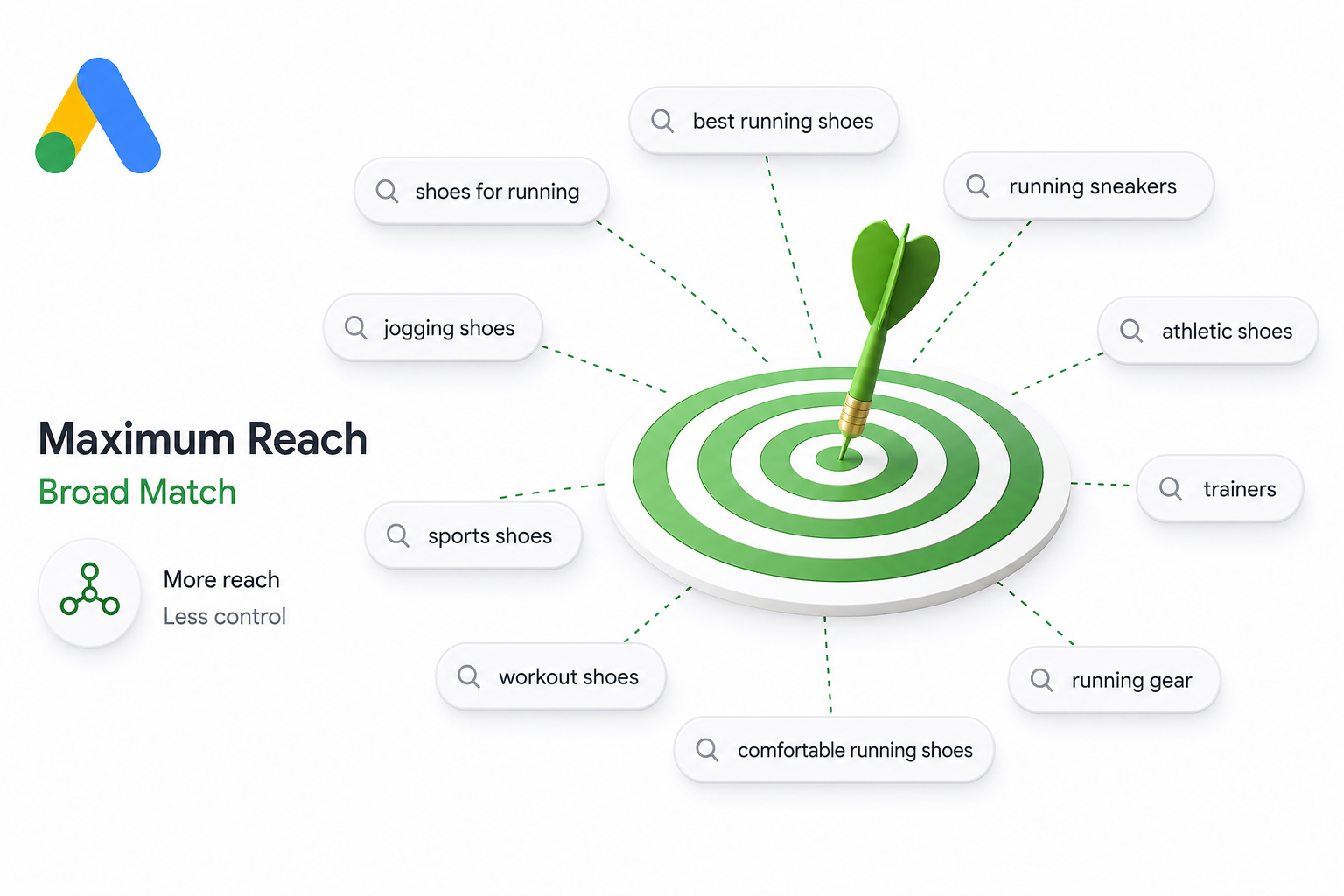
Broad Match: Maximum Reach
Broad match is Google’s default setting. Add a keyword to your campaign without specifying a match type and it’ll automatically run as broad match. With broad match, your ad can appear for searches that loosely relate to your keyword. That includes synonyms, related searches, and queries that share the general intent of your keyword. If your keyword is “running shoes,” your ad might show “best trainers for jogging,” “athletic footwear,” or possibly “how to start running.”
The upside is it gives you the widest possible audience and can bring up search terms you might not have thought to use yourself. Google’s machine learning uses signals from your landing page, existing keywords, and campaign history to match your ads to relevant searches. The downside, however, is without tight guardrails, broad match can burn through your budget on searches that have little to do with your actual offer. It’s a powerful setting when managed well, but it demands active, ongoing oversight.
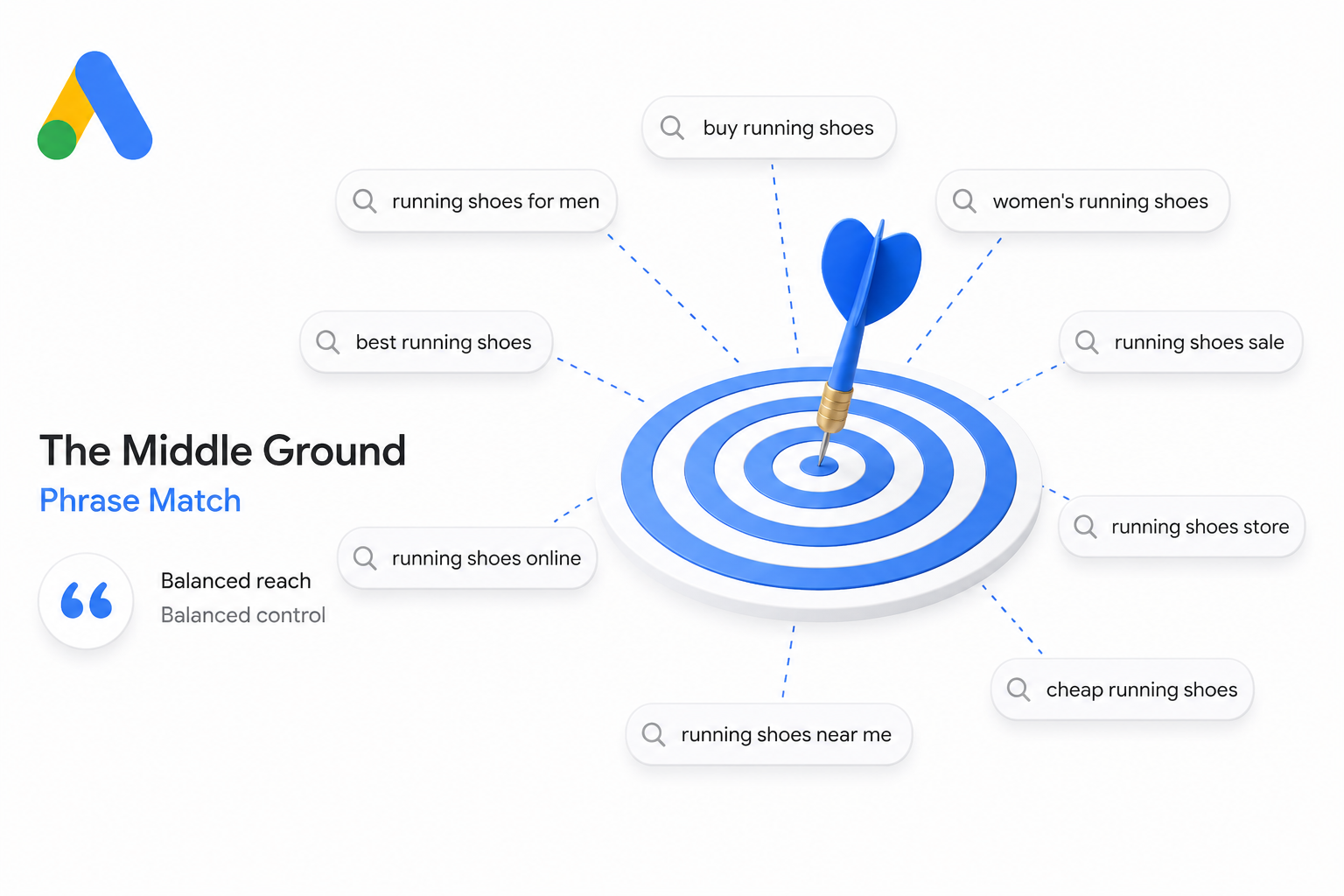
Phrase Match: The Middle Ground
Phrase match offers more control than broad match without the restrictions of exact match. Your ad shows searches that include the meaning of your keyword, in the right order, with words potentially added before or after it. If your keyword is “running shoes,” phrase match might trigger your ad for “best running shoes for women,” “running shoes under $100,” or “where to buy running shoes online.” Phrase match strikes a reasonable balance between reach and precision. You’re not locking yourself into a single search term, but you’re not showing up for every search that’s vaguely relevant either. It works particularly well for businesses that want to reach a defined audience without being overly restrictive, which is especially useful when you’re still gathering info on which search terms actually convert.
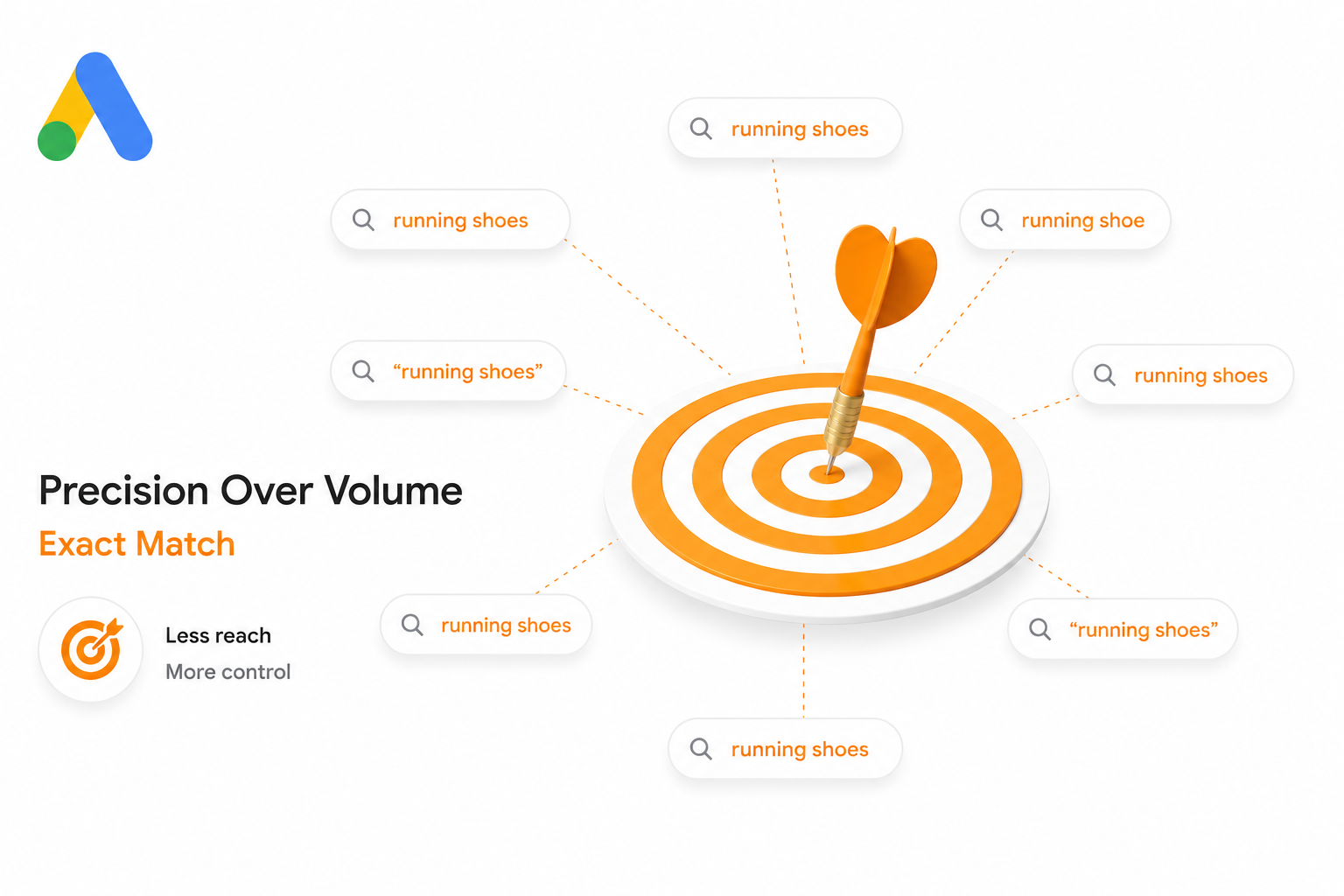
Exact Match: Precision Over Volume
Exact match is the tightest of the three options. Your ad only shows when someone searches for your exact keyword or a close variation, think singular and plural forms, minor misspellings, and reordered words that carry the same meaning. Using the same example: an exact match keyword for “running shoes” might show “running shoes” or “running shoe,” but not “best running shoes” or “cheap running shoes online.” Exact match delivers the cleanest data and the highest level of control over what triggers your ads. Conversion rates tend to be higher because you’re reaching people whose search intent lines up closely with what you’re offering. However, the limitation is volume. If you rely entirely on exact matches, you risk missing searches from people who are very much your ideal customer but have phrased things just slightly differently.
How Do You Choose the Right Match Type for Your Campaign?
The most effective campaigns don’t rely on a single match type. They use a combination, and the right mix depends on where you are in your campaign lifecycle.If you’re starting from scratch, broad match with smart bidding gives Google the room to learn what works. Review your search term report regularly and add negative keywords to filter out irrelevant traffic as you go. As you gather data, phrase match becomes more useful because it narrows down your focus while still giving you enough data to work with. Once you’ve identified your top-performing search terms, exact match lets you concentrate your budget on the queries that actually convert. Understanding how Google Ads keyword match types interact at each stage is what separates campaigns that learn and improve from ones that stay stuck burning through your budget on the wrong searches.
What Are Common Mistakes to Avoid With Match Types?
Relying entirely on broad match with no negative keywords is the most common, and most expensive, mistake. Without guardrails, your ads can show for searches that are entirely off-target. Negative keywords are what give broad match discipline.
Ignoring the search term report is a close second. Your keywords tell Google what you want to target. Your search term report shows what actually triggered your ads. Checking it regularly is the only way to know if your match types are doing their job, or working against you.
Setting and forgetting is another issue. Match type strategy isn’t a one-and-done. Search behavior shifts, Google updates how it interprets match types, and campaign goals evolve. What worked six months ago may not be the right structure today, so treat match types as an ongoing part of campaign management.
Getting your Google Ads keyword match types right takes testing, time, and a clear sense of what your campaigns are actually trying to achieve. If it’s executed well, match types are one of the most powerful levers you have for controlling what you spend and improving your return on ad investment. If you want a Google Ads strategy built around data, ready to perform from day one, Witthaya Digital can help. Our team manages paid search campaigns designed to drive real, measurable results. Get in touch with us today to find out what a properly built campaign looks like.